
Changing shape
What is it about poetry?


This last month I have had the enormous privilege of observing an outstanding practitioner delivering a writing course for the Royal Literary Fund. I have spoken of the wonders of the RLF on a number of occasions and, if you haven’t done so already, I strongly urge you to check it out - not least because it offers authors a way earning actual money.
The course I was observing was called ‘Writing for Self-Expression’ and it is offered specifically to those who are recovering from mental health trauma. The course is, as the RLF carefully and appropriately emphasises, ‘therapeutic but not therapy.’ It consists of four workshops, each two and a half hours long, during which the participants read two poems, one in each half of the workshop, discuss what that poem evokes for them, and then produce their own writing in response to what they have read, writings which they can then share with the rest of the group if they feel so inclined.
There were some interesting, amusing, and moving poems selected by the facilitator, and some remarkable writing produced by the participants, and the whole experience left me thinking about the whole nature and function of writing, and particularly of writing poetry.
Poetry in our culture stands in a particularly privileged position. A poem on a page appears to demand a different kind of attention from the list of ingredients on a pickle jar - just like a painting in an art gallery, it is saying ‘this is special, this matters.’ There is something about the shaping that tugs at our attention and makes us look more closely. That, I think, is one reason why the Writing for Self-Expression course was so successful - it enabled the participants to look at their responses to the poems they read with some degree of distance. A distance achieved partly by the act of writing itself, but more importantly by the fact that they were writing in response to another piece of writing - so that their lived experience was being mediated through their experience of another writer’s work.
As the superb American poet Jane Hirshfield says in Nine Gates, “a good poem also changes the shape of the self. Having read it, we are not who we were the moment before.” If that is true of the reader, it is at least as true of the writer. To have written something — to have found the words, shaped them, set them down — is to have altered, however slightly, one’s relationship to the experience they describe. The experience has not changed. But the writer has.
There is, though, a vexatious little word sitting quietly in Jane Hirshfield’s valuable observation, and that is the word ‘good.’ When I was writing my thesis - far, far in the distant past, when God was still wearing short trousers - I read all the poetry published in English and in French between 1912 and 1928. The thesis, catchily entitled Poetry and Violence (I’ve always loved titles, as you might have noticed), was a comparative literature study of French and English poetry during the First World War, and one of the things I feel I can say with some authority on the basis of that experience is that sincerity is no criterion of quality.

And here we get into very swampy territory, where every step threatens to drag you down and trap you under the roots of competing ideologies. Suffice it to say that I am wary in the extreme of the word Art (always with a capital ‘A’ and cloaked in a penumbra of Specialness). It doesn’t make me reach for my gun - alas my Roy Rogers toy cap gun is long lost - but it does make me sidle away to keep company with the much more modest ‘craft’ with its self-effacing lower-case ‘c.’ What survives to be valued is perhaps a matter a chance, but perhaps also a matter of having, with craft, distilled something which speaks to the human condition - a kind of Darwinian selection based on its effectiveness in helping us see and survive the multiple daily travails of being human.
Part of that ability to see, of course, comes from putting a distance between the self and the experience - just as the participants were able to do in the Self-Expression writing course. But those writings, striking as they were, were of the moment, and depended on their context for their force. To craft something that communicates demands, I think, something else of the writer - the ability, perhaps, to pay attention in a very particular way, and to endure the discomfort of not quite knowing until you can properly perceive what you have been paying attention to.
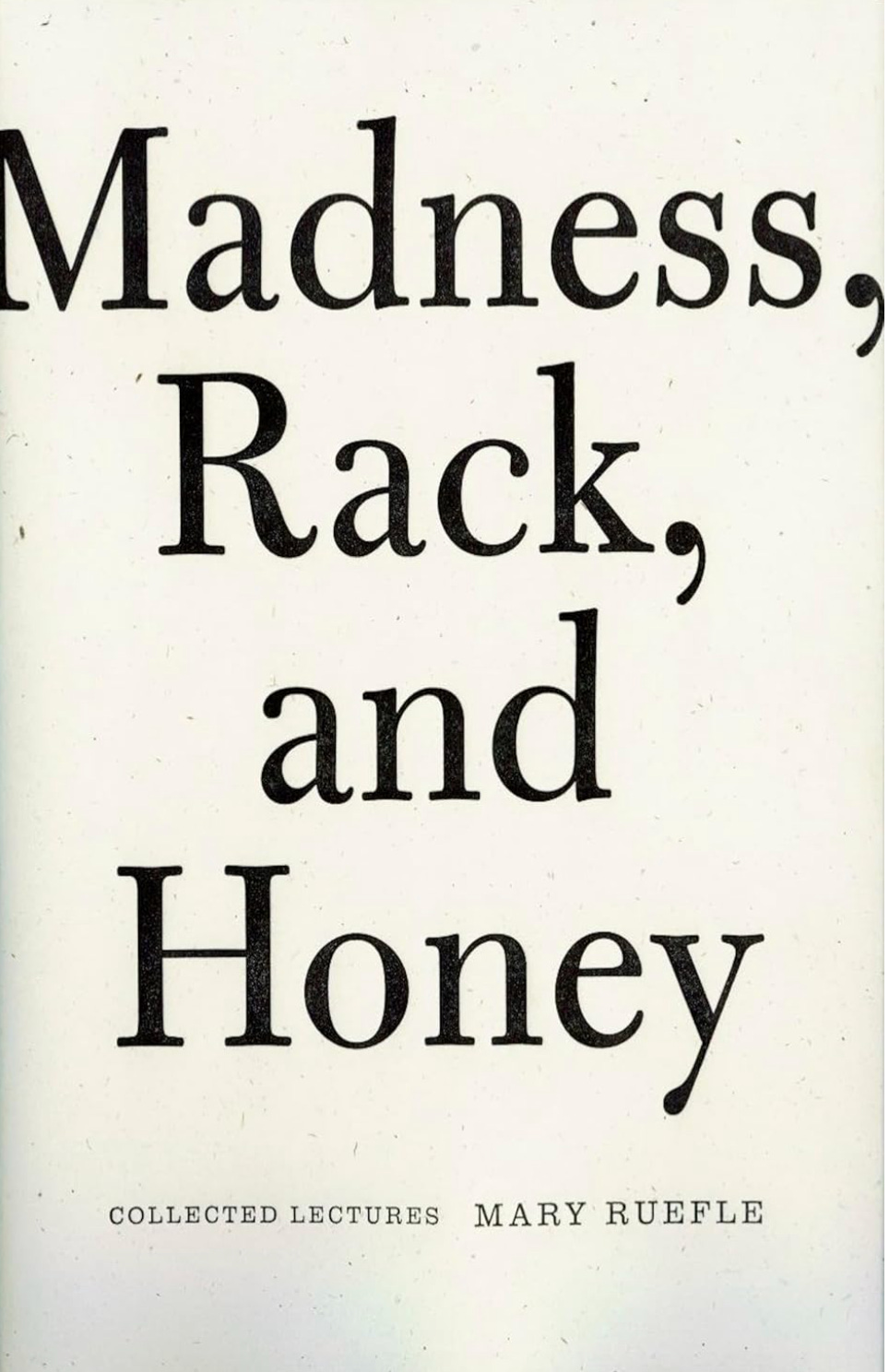
Mary Ruefle, in Madness, Rack, and Honey, says something which I think may be relevant here. She states that she continues to write “because I have not yet heard what I have been listening to.” That formulation — hearing what you have been listening to — captures something essential about what writing does for the writer. It is not the transmission of ready-made thought. It is the process by which thought, feeling, or experience becomes visible to the person who is having it. You write, and in writing, you see. And, if you’re lucky as a reader and if the writer has somehow managed to enable what they ‘have been to listening to’ to sing on the page, you too hear something which was till then unheard.
All of which is getting rather sententious and overly abstract. Better, I think, to end with a poem:
The Power of Poetry
Things fall apart
And anarchy let loose,
It was only poetry he found
Which had any use
So he reached for his copy
of the Complete Works of Yeats
And bludgeoned the President
Of the United States
Brian Bilston
Thoroughly enjoyable! Quite profound — and a totally unexpected end poem! X